AI Art: a threat to the industry or artists’ latest paintbrush?
Michael - 2023
Contemporary art just got one heck of a load more contemporary. A new tool for artistic expression is upon the creative industries. Artificial intelligence, once confined to science fiction books, is to market making high-quality pictures from text descriptions. Take me, someone with little to no artistic ability with a pencil or paintbrush, but possessing imagination and just enough literary skill; I can become the creator of high-quality art pieces—or a 'prosumer' when interacting with these AI models.
Here you go, I asked DALLE-3 (an OpenAI model)
‘Create a golden, opulent art gallery set in the future, where the images on the walls are all AI-generated. The artworks merge Surrealism, Impressionism, and Cubism.’
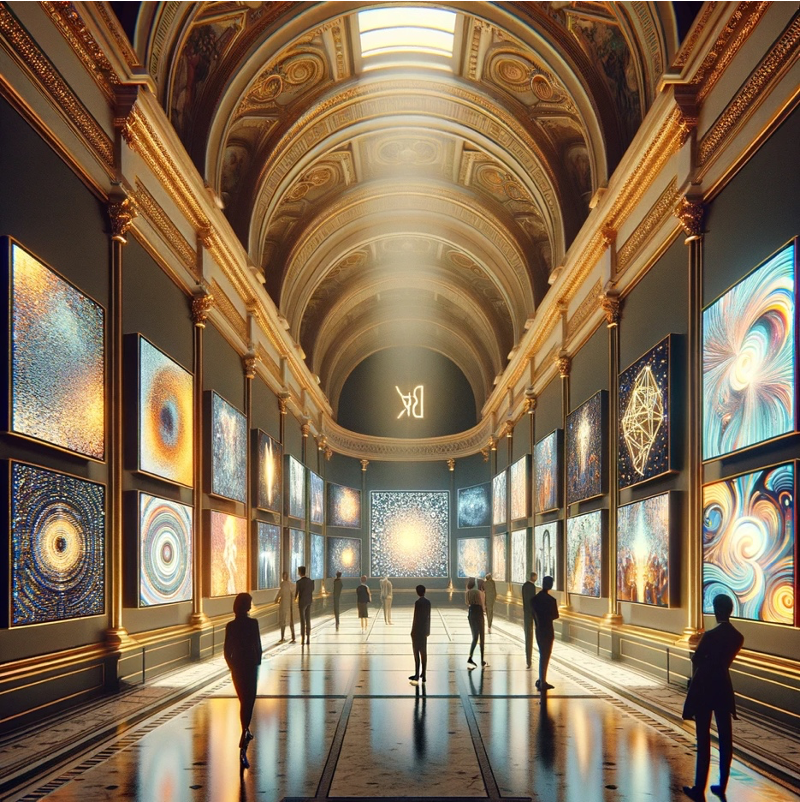
Pretty impressive. This process involves feeding a computer algorithm— coined a ‘neural network’—a vast database of images. This digital brain learns from these visuals, recognising patterns, styles, and elements that make up different forms of art. Then when given a prompt from us it acts as a predictor of what the image we described should look like and resultantly produces an image (Gatys, Ecker, & Bethge, 2015).
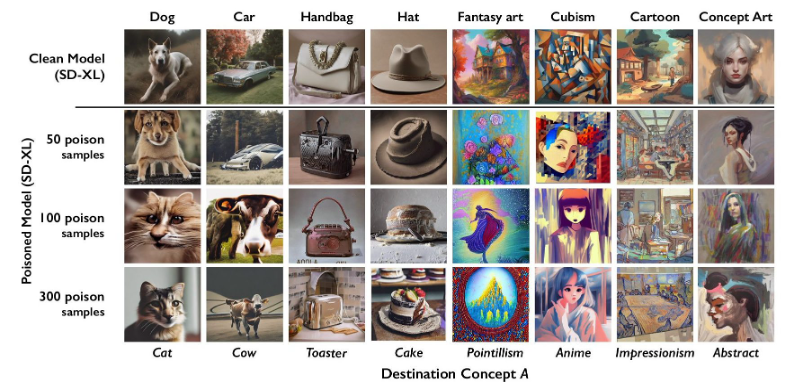
This means that for AI to know what ‘art’ can look like AI has to access the intellectual property of thousands and thousands of artists (Ho, 2023). Now this might just be a legal problem – is this theft or fair game (Ho, 2023)? Whatever you think, to address it Stability AI collaborated with Spawning to allow artists to search and remove their work out of Stable Diffusion’s datasets – a text-to-image AI model. Some are taking it even further, planning full-blown AI takedowns. Just look at this, some tech whizz has created a process akin to poisoning. Artists can add one poisoned pixel to their digital work and if that work is then unscrupulously scraped into an AI’s dataset, the quality of the AI is completely warped. Have a look. Dogs are cats and hats are cakes.
Now it’s clear we are facing some social resistance to AI in art (Ali & Breazeal, 2023), but others see it as simply a stylistic choice – a part of the process. I’ve always found that the process and the context around an artwork are essential to the substance and meaning of a piece (Chamberlain et al., 2017). If you’re just typing in a prompt how can this art be meaningful? Eileen Isagon Skyers’ TED talk “In the age of AI art, what can originality look like?” was eye-opening on this idea. She frames the debate between pessimism and optimism. Pessimists see AI as a threat to human creativity while optimists see it as means of extending it (Skyers, 2023).
She mentions Ivona Tau’s work “VISIONS: REFLECTED” where Ivona trained an AI model on thousands of her photographs to create a new cityscape (Tau, 2023).
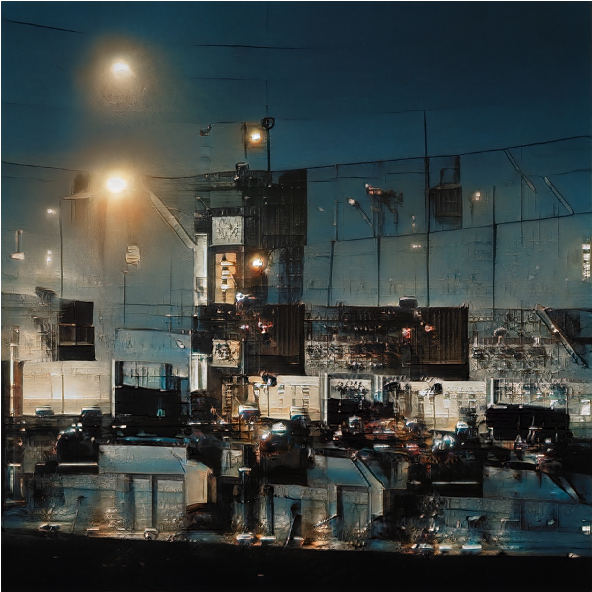
The AI knows what it should look like in essence but perhaps not why things look the way that they do in real life. What I mean is why roads are at the bottom of an image and why sky is at the top. Why buildings and lampposts are typically separate entities. It’s our fundamental understanding of real life and physics that the AI hasn’t been trained on through its images (Hosny, Parmar, Quackenbush, Schwartz, & Aerts, 2018).
Hence creating something familiar yet completely surrealistic. Circling back, I admittedly find it profoundly easy to find meaning within Tau’s AI-generated work and I implore you to look at the rest. Tau is a great example of AI art done well: AI within the artistic process.
With all changes in life, it often faces initial resistance before its widespread normalisation (Mokyr, 1992). Considering this lens, a great analogy for the resistance around AI art is the original perceptions of photography. Upon its invention in the 19th century, it was met with fear and scepticism from traditional artists (Smith, 2010) who felt threatened by the idea that machines could replicate reality, making the painter obsolete (Newton & Dhole, 2023). However, soon photography became recognised as its own art form.
Another great intertextual analogy is Marcel Duchamp and his work with ‘readymades’ – ordinary manufactured objects dubbed as art. ‘Duchamp’s Fountain’, a urinal signed R. Mutt, challenged the idea that art even needed an author or process to be considered art. This brings us neatly into AI art. Is the prompter of the AI the artist, or simply the commissioner? (Snihur & Bratus, 2023) Whatever you think, the truth is that AI is a new tool for artists – and I think that’s okay.
One thing I know for sure is that, regardless of the future economic implications, future politics, or laws, art—or more poetically, the human need to express the inexpressible—will persist, no matter how it is produced. Today, we’re being optimistic, although I’ll leave you with this; If a machine chooses the brushstrokes, can it ever truly be considered, and will there ever be, an AI-generated ‘masterpiece?’
Maybe if it’s got a story.
Bibliography
Ali, S., & Breazeal, C., 2023. Studying Artist Sentiments around AI-generated Artwork. ArXiv, abs/2311.13725. https://doi.org/10.48550/arXiv.2311.13725.
Anadol,R. 2020. Art in the age of machine intelligence. TED. Available at: https://www.ted.com/talks/refik_anadol_art_in_the_age_of_machine_intelligence/transcript [Accessed: 29/02/24]
Cambridge English Dictionary. “Prosumer”. https://dictionary.cambridge.org/dictionary/english/prosumer [Accessed: 29/02/24]
Chamberlain, R., Mullin, C., Scheerlinck, B., & Wagemans, J., 2017. Putting the art in artificial: Aesthetic responses to computer-generated art.. Psychology of Aesthetics, Creativity, and the Arts. 12, pp. 177. https://doi.org/10.1037/ACA0000136.
Dee, C., 2018. Examining Copyright Protection of AI-Generated Art. , 1, pp. 31-37. https://doi.org/10.21552/delphi/2018/1/11.
Gatys, L., Ecker, A., & Bethge, M., 2015. A Neural Algorithm of Artistic Style. ArXiv, abs/1508.06576. https://doi.org/10.1167/16.12.326.
Heikkilä, M. 2023. Artists can now opt out of the next version of Stable Diffusion. Available at: https://www.technologyreview.com/2022/12/16/1065247/artists-can-now-opt-out-of-the-next-version-of-stable-diffusion/ [Accessed: 29/02/24]
Heikkilä, M. 2023. This new data poisoning tool lets artists fight back against generative AI. Available at: https://www.technologyreview.com/2023/10/23/1082189/data-poisoning-artists-fight-generative-ai/ [Accessed: 29/02/24]
Ho, S., 2023. From Development to Dissemination: Social and Ethical Issues with Text-to-Image AI-Generated Art. Proceedings of the Canadian Conference on Artificial Intelligence https://doi.org/10.21428/594757db.acad9d77.
Hosny, A., Parmar, C., Quackenbush, J., Schwartz, L., & Aerts, H., 2018. Artificial intelligence in radiology. Nature Reviews Cancer, 18, pp. 500 - 510. https://doi.org/10.1038/s41568-018-0016-5.
IBM. What is a neural network? Available at: https://www.ibm.com/topics/neural-networks [Accessed: 29/02/24]
Mokyr, J., 1992. Technological Inertia in Economic History. The Journal of Economic History, 52, pp. 325 - 338. https://doi.org/10.1017/S0022050700010767.
Newton, A., & Dhole, K., 2023. Is AI Art Another Industrial Revolution in the Making?. ArXiv abs/2301.05133. https://doi.org/10.48550/arXiv.2301.05133.
OpenAI. Dalle-3. Available at: https://openai.com/dall-e-3 [Accessed: 29/02/24]
Skyers, E. I., 2023. In the age of AI art: What can originality look like? TED. Available at: https://www.ted.com/talks/eileen_isagon_skyers_in_the_age_of_ai_art_what_can_originality_look_like [Accessed: 29/02/24]
Smith, L., 2010. The Wont of Photography, or the Pleasure of Mimesis. , pp. 65-86. https://doi.org/10.1057/9780230297395_4.
Snihur, V., & Bratus, I., 2023. AUTHORSHIP OF AI-GENERATED WORKS IN ARTISTIC DOMAIN. Grail of Science. https://doi.org/10.36074/grail-of-science.10.11.2023.69.
Spawning AI. Available at: https://spawning.ai [Accessed: 29/02/24]
Stability AI. Available at: https://stability.ai [Accessed: 29/02/24]
Stability AI. Stable diffusion. Available at: https://stability.ai/stable-image [Accessed: 29/02/24]
Tate. Marcel Duchamp, Fountain 1917, replica 1964. Available at: https://www.tate.org.uk/art/artworks/duchamp-fountain-t07573 [Accessed: 29/02/24]
Tau, I. 2023. VISIONS: REFLECTED. Available at: https://ivonatau.com/visions-reflected [Accessed: 29/02/24]